SoFi Stadium for FIFA World Cup 2026: Inside Los Angeles' Cinematic Football Venue
SoFi Stadium hosts FIFA 2026 in Los Angeles. Inside guide to seats, transit, LA matchday culture, weather, history, and traveling fan tips for the World Cup.

Ricerca e revisione di Abdullah Mashuk. Redatto con ricerca assistita dall'IA secondo la nostra Metodologia.
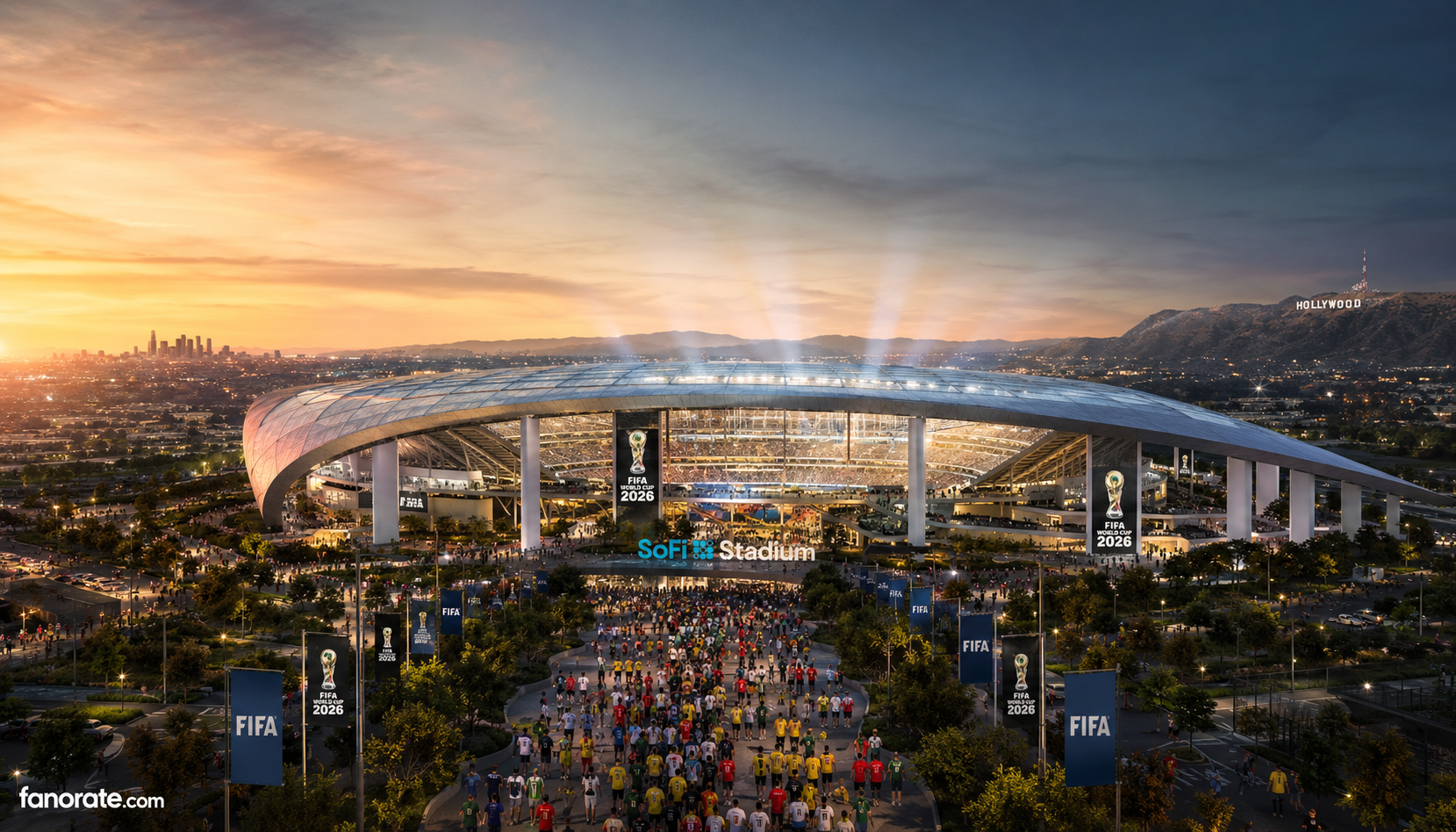
Illustrazione generata dall'IA. Non è una fotografia reale.
SoFi Stadium for FIFA World Cup 2026: Inside Los Angeles’ Cinematic Football Venue
You don’t really walk into SoFi Stadium. You walk under it.
The whole building floats. Its glass-and-steel canopy stretches across the bowl like a translucent cloud, lit from beneath by a halo of LED panels, and a moving river of fans pours up the open-air concourses into seats that look out toward Hollywood, the Pacific, and a sky that almost never gets in the way. Of all the venues hosting the 2026 FIFA World Cup, SoFi Stadium might be the one that feels least like a stadium and most like a movie set built around one.
That’s appropriate. This is Los Angeles. Football has been quietly remaking this city for decades — through East LA pickup leagues, the rise of LAFC, the long love affair with Liga MX, the diaspora of fans from every continent. The 2026 World Cup is going to make it loud.
Here’s everything fans need to know about SoFi Stadium as a host venue, and about Los Angeles as the city wrapped around it.
Quick Venue Snapshot
- Stadium: SoFi Stadium
- City / Region: Inglewood, California — Greater Los Angeles
- Country: United States
- Capacity: Approximately 70,000 for standard configuration; expandable past 100,000 for marquee events
- Opened: 2020
- Primary tenants: NFL’s Los Angeles Rams and Los Angeles Chargers
- FIFA 2026 matches hosted: Eight matches, including group-stage games, a Round of 32, a Round of 16 and a Quarterfinal
- Location: Hollywood Park district of Inglewood, roughly 5 km (3 miles) east of LAX
- Surface for FIFA 2026: Natural grass pitch installed specifically for the tournament
- Roof: Translucent fixed canopy — covered from above, open on the sides
- Climate considerations: Warm-to-hot summer days, mild evenings, near-zero rain in June and July
- Transit: Light rail Metro K Line station nearby; rideshare and shuttle networks are dominant for most fans
The Story of the Stadium
If you visited Inglewood twenty years ago and asked a local what would replace the old Hollywood Park racetrack, almost no one would have answered “the most expensive stadium ever built.” But that, in the end, is what happened.
Construction broke ground in 2016, after years of legal and political wrangling over whether the NFL would return to Los Angeles at all. By the time the project was finished — delayed by weather, by a pandemic, and by sheer ambition — SoFi Stadium had reset the expectations for what a multi-purpose American venue could be. The reported cost was north of five billion dollars. The roof alone, a structure of tensile cables and ETFE panels, looks more like an architectural moonshot than a piece of stadium infrastructure.
Within two years of opening, the building hosted Super Bowl LVI, a College Football Playoff National Championship, the closing rounds of major international concerts, and a calendar of football friendlies that drew some of the highest crowd numbers ever recorded in the Los Angeles area for the sport. In 2023, a friendly involving Lionel Messi reportedly drew a sell-out so well-attended that staff began turning fans away from the standing-room areas hours before kickoff. The football market here is real, and SoFi has become its largest indoor-feeling room.
For FIFA 2026, the playing surface is being rebuilt for football. Pitch dimensions will widen to true international standards. The synthetic field installed for NFL use is being replaced with natural grass. By the time the tournament arrives in June 2026, the venue will look — and feel — like a purpose-built football stadium for the duration of the competition.
What Makes SoFi Unique
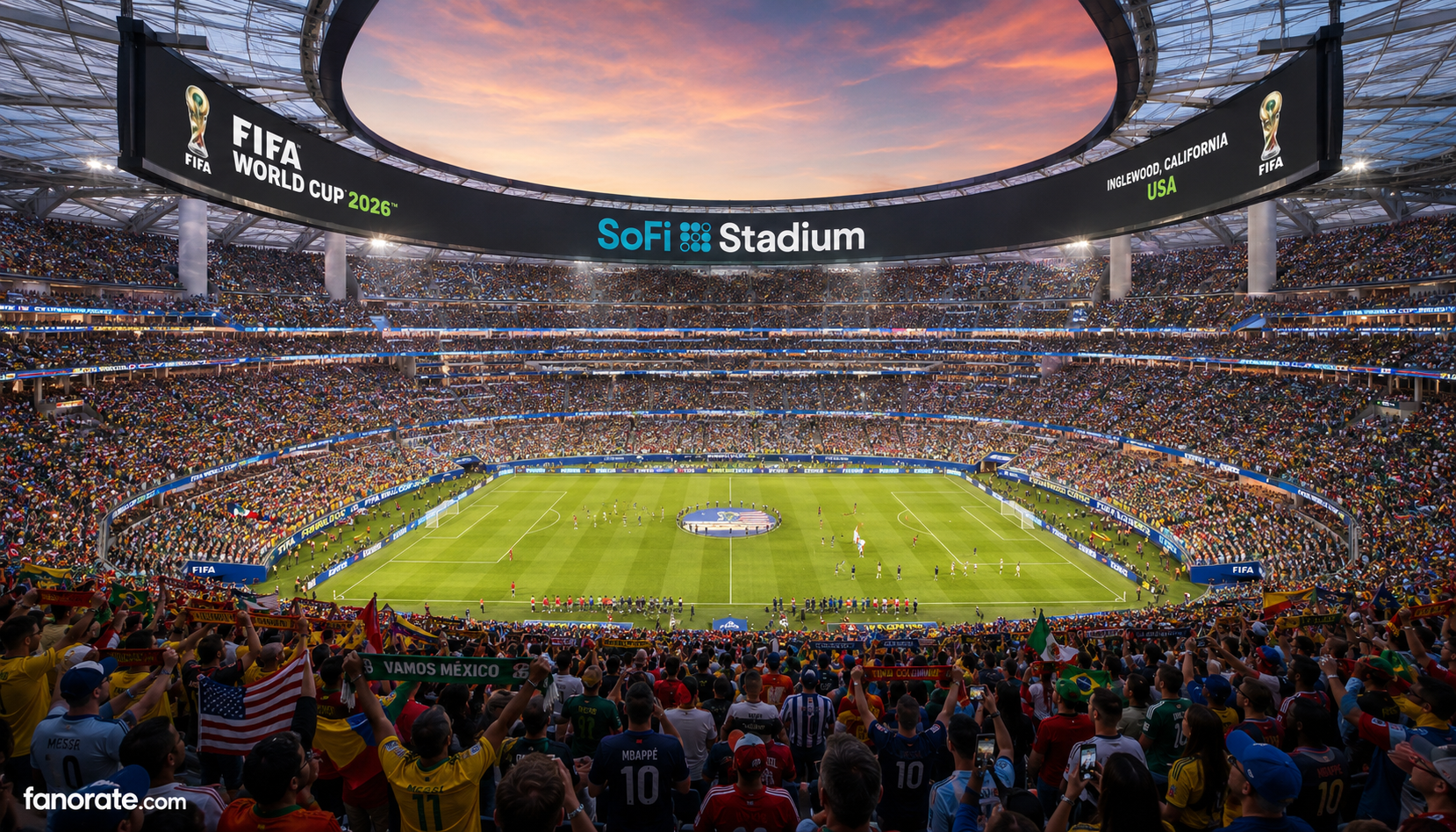
The building is famous for one thing above all: the Infinity Screen.
Picture an oval video board the size of a wide-bodied airliner, suspended in the middle of the bowl, with screens facing every direction including straight down. Players walking through the tunnel see it. Fans in the upper bowl get full HD replays from every angle. From the field, looking up, the screen is so large it warps your sense of architectural scale. Most stadiums fight for sightlines with a single jumbotron. SoFi just made the jumbotron its central design feature and built the rest of the bowl around it.
Other distinctive elements:
- The roof is fixed and translucent. It blocks rain, blocks direct sun on the field, and lets enough daylight through that the bowl never feels dim during day matches.
- The sides of the building are completely open. Wind moves through. So does conversation between people in the upper concourse and people in the surrounding plaza.
- Concourses face outward. You can step away from your seat and look at the airport, the freeway, the hills, the moon.
- The complex around the stadium — Hollywood Park — includes a smaller indoor venue, restaurants, retail, an artificial lake, and event spaces. It’s designed to be busy hours before a match begins and hours after it ends.
- The lighting system around the building can transform the canopy’s color in coordinated displays. For international matches, expect the canopy to flicker through tournament and team colors.
The combination is unusual. SoFi is fundamentally an outdoor stadium that feels indoor when you’re in it. For Los Angeles weather — overwhelmingly mild — that’s an advantage. For Southern California fans used to baseball and basketball in air-conditioned arenas, it’s a familiar bridge to a sport that traditionally lives outside.
Why FIFA 2026 Picked Los Angeles
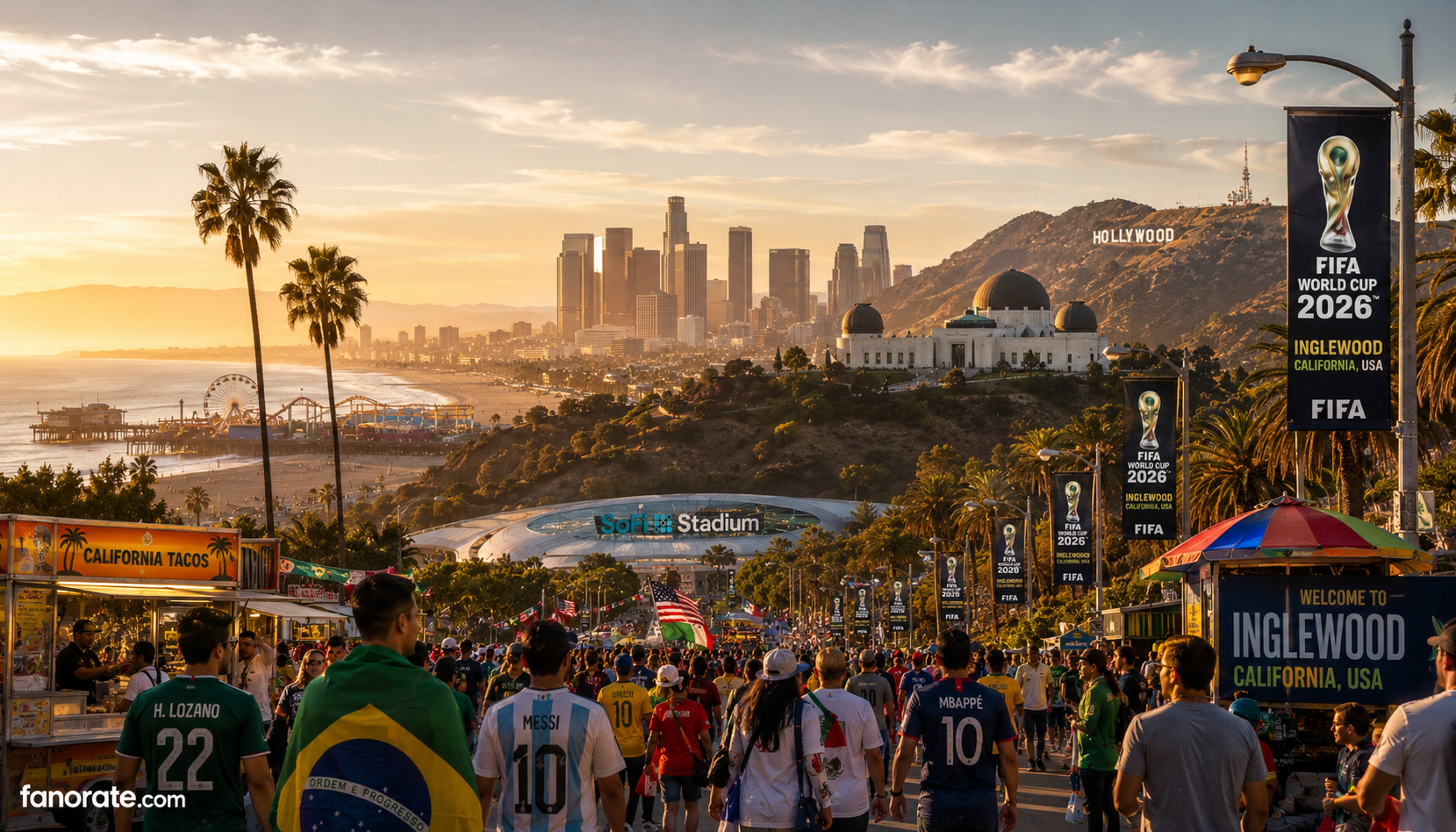
You don’t host a global tournament in North America without putting matches in Los Angeles. The numbers — population, media reach, international airport traffic, latent football culture — make it unavoidable. The question was always which LA venue, and the answer was always going to be SoFi.
Three factors mattered. First, capacity. SoFi can hold one of the largest crowds among all 2026 venues, which gives FIFA flexibility for high-profile matches. Second, infrastructure. The stadium has been built for global broadcasts, complex security operations and high-touch hospitality at scale. Third, location. LAX is one of the world’s busiest international airports, and SoFi is essentially next door.
The schedule reflects all of this. Eight matches at SoFi span the group stage and four knockout rounds. A Quarterfinal here will likely feature one of the favorites and will be one of the biggest single nights in Los Angeles sports history. The 2026 tournament will also turn the Hollywood Park district into a fan-festival hub of its own, with watch parties at every plaza, hospitality activations across the complex and a constant pulse of supporter culture moving through.
If MetLife is the closing act of the tournament, SoFi is where its biggest cinematic moments are most likely to be staged.
Iconic Matches and Historic Moments
SoFi is young, but in five short years it has piled up the kind of cultural moments that take older venues decades to accumulate. Super Bowl LVI delivered the Rams a championship in their own building — a moment New Yorkers and Bostonians have lived through repeatedly but Los Angeles had been waiting on for years. The College Football Playoff National Championship turned the bowl into a quasi-home stadium for one of the most powerful programs in the country. Concerts have repeatedly broken attendance records for outdoor music in Southern California.
In football specifically, SoFi has already hosted:
- Major Liga MX and South American club friendlies with crowds that rival domestic finals.
- USMNT international fixtures.
- Sell-out matches involving Lionel Messi, the Mexican national team, El Clasico-style friendlies between European giants, and high-stakes CONCACAF Champions Cup-related events.
- CONCACAF tournament matches at the building.
Some of these games drew six-figure attendances when SoFi was expanded into its maximum configuration. The football demand in Los Angeles has been there for a long time. The building can simply finally hold all of it.
Football Culture in Los Angeles
You cannot talk about LA football without talking about Liga MX. Mexican football is not a “subculture” here. It is football, in the same way that Italian opera was not a subculture in 19th-century Naples. Generations of Angelenos grew up watching Chivas–America from kitchen tables, jerseys older than the children wearing them, the games as much a family ritual as a sporting one.
Add to that the city’s deep Central American, South American, Korean, Filipino, Armenian, Iranian, Brazilian, Nigerian and Eastern European football diasporas, and you get one of the most varied football cultures in the United States. LAFC has built one of the loudest stadium atmospheres in MLS. The LA Galaxy is one of the most decorated franchises in American soccer history. Local supporter culture is bilingual, multi-generational and theatrical.
Then there’s youth football. Los Angeles produces more professional and national-team caliber players per capita than nearly any other American region. Watch any youth tournament weekend across the San Fernando Valley, East LA, South Bay or Inland Empire and you’ll see why. The fields are full. The competition is fierce. The 2026 World Cup is going to walk into a city that already speaks the sport’s grammar.
For traveling supporters, this means three practical things: bars will be open, food will be excellent, and you will not have to explain who your team is.
Matchday at SoFi: What to Expect
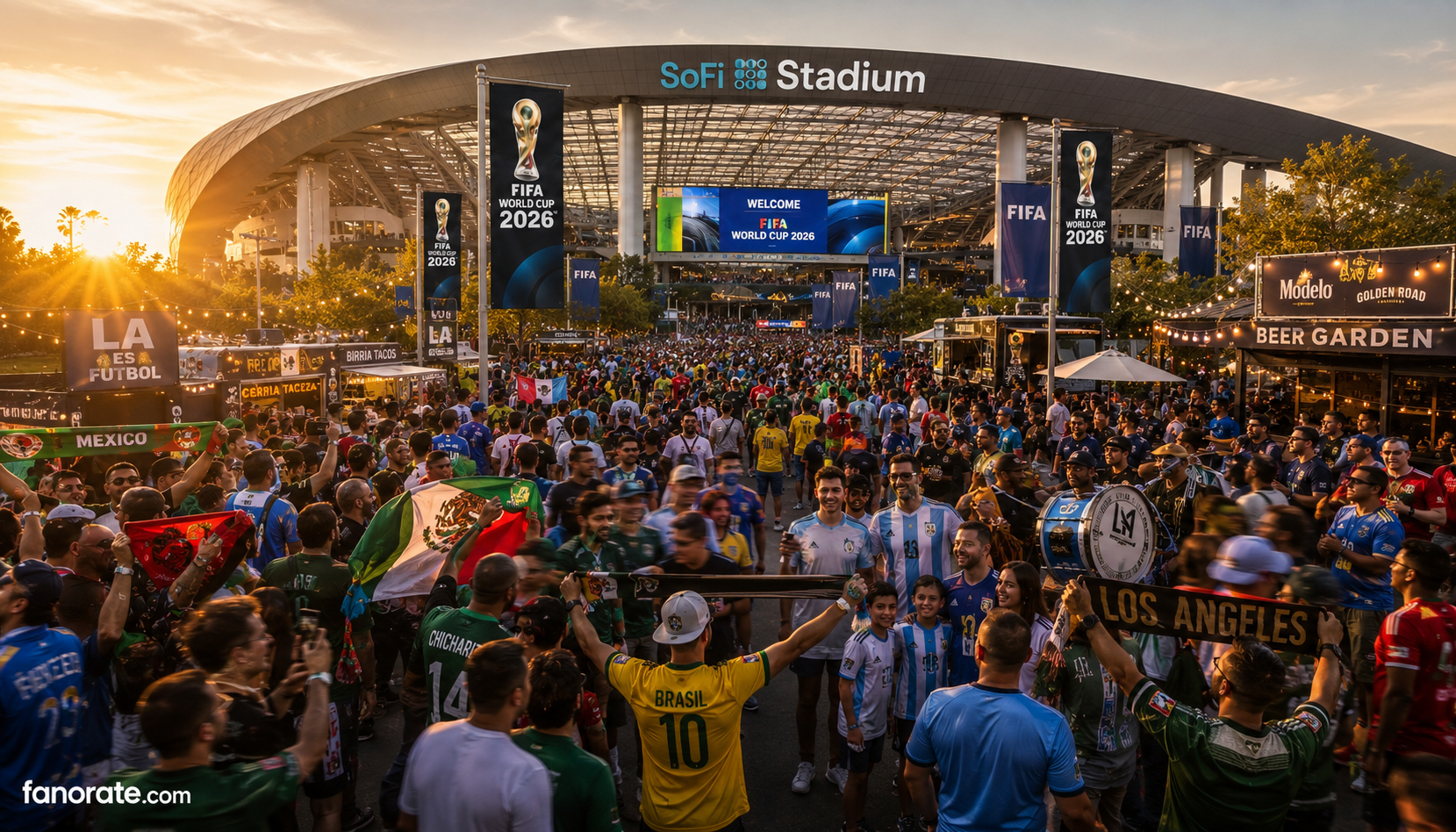
Plan around traffic. That’s the headline. Everything else follows.
A typical SoFi matchday rhythm:
- Morning and early afternoon in your base neighborhood. Beach run, breakfast burrito, a coffee shop with World Cup viewing parties already in progress.
- Travel to Inglewood. Most fans arrive by rideshare, by car, or by a combination of Metro rail and shuttle. Allow at least an hour even from neighborhoods that look close on a map.
- Hollywood Park plaza. Get there early. The plaza around SoFi is built for pre-game crowds. Expect food trucks, fan zones, supporter group activations and live music.
- Entry. Security is strict. Clear-bag policy applies. Gates open well before kickoff for major fixtures.
- Inside the bowl. The Infinity Screen does most of the talking. The crowd noise pattern is unusual — sound moves up and out through the open sides rather than building inside a closed dome.
- Halftime and concessions. Quality of stadium food at SoFi is widely regarded as among the best in North America. Don’t skip the line.
- Post-match. Either stay in the complex and let the crowd disperse, or pre-book your rideshare for a known pickup zone. The worst single decision in an LA matchday is trying to leave SoFi at the same time as everyone else.
Best Seating Guide
- For atmosphere: Lower-bowl seats behind the goals. Supporter sections from visiting nations will tend to consolidate here. Expect chants in multiple languages.
- For tactical viewing: Mid-tier sideline seats between the 18-yard boxes. The bowl is engineered to give you a clean view of the entire pitch geometry.
- For photography: Upper-deck corners. You catch the canopy curve, the Infinity Screen, the field and the sky in one frame.
- For families: Mid-bowl sideline seats away from the most vocal supporter sections. Easier exits, simpler concessions, comfortable sight lines.
- Budget seats: Upper bowl corners. With strategic resale-platform timing, especially for group-stage matches, you can find legitimately affordable World Cup tickets here.
- Premium experience: Field-level clubs, the BMO Tunnel Club-equivalent areas, and the indoor lounges that connect to the seating bowl. These are the most coveted seats for major fixtures.
A SoFi-specific note: the Infinity Screen is visible from essentially every seat. Even from the highest corner, the in-game video experience is unusually good. This makes upper-deck seats more attractive at SoFi than at most venues.
Transportation and Access Guide
This is the section most fans get wrong about LA. Read it twice.
- LAX to SoFi: Roughly 8 km (5 miles), but allow 30–45 minutes by car in normal traffic and longer on matchday. Designated rideshare pickup is available at LAX.
- Downtown LA to SoFi: Around 20–30 km depending on route. Plan for 45–75 minutes by car. Metro K Line + a connecting shuttle is a viable transit option.
- Hollywood / West Hollywood to SoFi: 30–45 minutes by car. Metro options exist with transfers.
- Santa Monica / West LA to SoFi: 30–60 minutes by car. Multiple bus and shuttle services run on matchdays.
- Parking: Pre-paid lots are essential. Walk-up parking at SoFi on a major-match day is unlikely to exist at any reasonable price.
- Rideshare: Designated zones around the complex. Surge pricing post-match is steep. Pre-booking helps.
- Public transit: Metro K Line connects to the broader rail network. A people-mover system around the stadium and connecting transit has been part of long-running infrastructure plans for the World Cup.
- Accessibility: SoFi has been built to modern ADA standards. Step-free routes connect all seating tiers. Coordinate ADA shuttle access with FIFA’s accessibility services in advance.
The honest advice: if you can avoid driving, do. If you have to drive, leave embarrassingly early.
Where Fans Should Stay
Los Angeles is geographically vast. Choosing a base matters more here than in any other US host city.
- Inglewood and Hollywood Park area: Closest to the stadium. Limited hotel inventory but fast-growing as a destination. Best for fans planning multiple matches at SoFi who want to minimize commuting.
- El Segundo and Manhattan Beach: Near LAX, near SoFi, near the ocean. A practical and pleasant base.
- Santa Monica and Venice: Iconic beach-and-pier LA, lively nightlife, walkable. Longer matchday commute but a great World Cup vibe.
- Downtown LA: The hotel inventory hub. Fan festivals and viewing parties will likely cluster here. Strong Metro access. Decent connection to SoFi.
- West Hollywood and Hollywood: Classic LA nightlife district. Some traveling supporter clubs will base themselves here. Long matchday commute.
- Pasadena: Quieter, walkable, with one of the more pleasant downtowns in the region. Long commute to SoFi but worth it for fans who want a calmer base.
- Long Beach: Underrated. Affordable, close enough, with a working waterfront identity.
A useful rule for first-time visitors: pick one neighborhood and commit. Hopping across LA every day will burn an hour of your trip you don’t get back.
Food, Drink and Nightlife
LA’s food is genuinely one of the best urban experiences on the planet. Tournament travelers will eat well, often, and across more cuisines than they can plan for.
- Tacos: Non-negotiable. Birria, al pastor, lengua, suadero. The taco trucks of East LA, Boyle Heights and South Central are pilgrimage sites. The grease-paper bowls of consomé alongside birria tacos are practically a citywide religion.
- Korean food: Koreatown is one of the great urban food districts in the United States. Korean BBQ, kimchi jjigae, soft tofu stew. Open late. Built for nights after late kickoffs.
- Persian and Armenian food: Glendale and the West Side. Stews, kebabs, saffron rice.
- Salvadoran cuisine: Pupusas in the Westlake/Pico-Union area.
- Vietnamese food: Little Saigon in Orange County is a longer drive, but excellent.
- Japanese food: Sushi in Little Tokyo, ramen across the city, izakayas with World Cup viewing parties.
- California cuisine: Farmers’-market driven menus, with strong vegetarian options.
- Coffee: LA’s third-wave coffee scene is its own industry. Find a neighborhood roaster.
- Bars and nightlife: Beer halls in Highland Park, rooftop bars downtown, dive bars in Echo Park, soccer-specific pubs growing in Hollywood and Culver City.
A note on viewing parties: LA is one of the best cities on earth to watch a game you don’t have a ticket for. Find a bar tied to your nation’s fan community. The atmosphere is sometimes louder than the stadium.
Things To Do Near the Stadium
The Hollywood Park complex itself is dense with food, retail, smaller event venues and a lake-anchored plaza. You can fill two hours easily before a match without leaving the property.
Beyond that, the LA classics:
- Hollywood Sign, Griffith Observatory and the surrounding park
- Santa Monica Pier and the Venice Boardwalk
- Getty Center and Getty Villa
- LACMA and the Academy Museum of Motion Pictures
- The Broad and MOCA downtown
- Hollywood Walk of Fame
- Beach towns: Manhattan Beach, Hermosa Beach, Malibu
- Hiking in Runyon Canyon, Topanga, and Eaton Canyon
- Universal Studios Hollywood (for families)
- Olvera Street and the historic core of downtown
- Catalina Island as a day trip
LA also has the densest concentration of football-themed pop-up culture in the country during World Cup summers. Watch for muralists, sneaker brands, soccer apparel collabs and fan-festival activations during the tournament.
Weather and Match Conditions
You came at the right time of year. Los Angeles in June and July is one of the most weather-friendly climates of any World Cup host city in 2026.
- Daytime temperature: Typically 75–85°F (24–29°C). Heat waves over 90°F (32°C) happen but are uncommon at the coast.
- Evening temperature: Cool. Often 60s by night. Bring a layer for late kickoffs.
- Humidity: Low compared to East Coast and Gulf venues. Air feels dry.
- Rain: Essentially zero in June/July. The rainy season is over by late spring.
- Marine layer: A coastal cloud cover often hangs over the LA basin in early summer mornings (“June Gloom”). It usually burns off by midday but can keep stadium-area temperatures milder.
- Wind: Moderate. The canopy and open sides mean breezes pass through the bowl during matches.
Practical kit:
- Sunscreen, hat and sunglasses for day matches
- Light jacket or hoodie for night kickoffs
- Hydration plan — LA’s dry air dehydrates fans quickly
- Comfortable walking shoes for plaza time and long rideshare walks
Interesting and Fun Facts
- SoFi Stadium is built lower than street level — much of the seating bowl is excavated below grade, which is part of how the architects achieved its dramatic open-sided look without overwhelming the surrounding neighborhood.
- The Infinity Screen is the largest video board ever installed in a sports venue. Look directly up at it from a lower-bowl seat for an immediate sense of scale.
- The canopy uses ETFE panels — a transparent polymer also used in modern building facades — that filter sunlight without blocking it.
- The Hollywood Park area, where the stadium sits, was once a thoroughbred racetrack hosting Hollywood-era celebrities. Pieces of the old racetrack heritage are subtly referenced in the surrounding plaza design.
- SoFi has hosted record-setting concert residencies from some of the biggest names in global music — including multi-night runs that effectively repurpose the stadium into a concert mode for weeks at a time.
- The bowl can be physically expanded for special events, with additional seating sections lowered or raised to fit specific configurations.
- The stadium’s neighbor, the Kia Forum, is one of the most storied basketball and concert venues in American sports history.
One Thing Most Fans Don’t Know
There’s a Mexican-American football pickup tradition in South Los Angeles that predates the modern professional game in this country by decades. On any given Sunday — not Football Sunday, regular Sunday — fields across South LA and Inglewood fill with hundreds of players in eleven-a-side recreational leagues that have produced a startling number of professional and international players over the years. When you’re heading to SoFi for a 2026 World Cup match and pass an open field with grown men in their forties playing forty-meter passes off the inside of their boots, those are the leagues. Some have run continuously since the 1960s. They are part of why LA was always going to be a football city, and part of why this stadium ended up in this neighborhood.
Photo and Social Media Spots
- Stadium exterior canopy. Late afternoon, when the sun catches the panels and the canopy looks like it’s lit from inside.
- The Hollywood Park plaza at golden hour. Reflections off the lake, palm tree silhouettes, distant skyline.
- Inside the bowl with the Infinity Screen overhead. Wide-angle, looking straight up.
- From the airport approach. Plane window shot of SoFi from the air as you fly into LAX.
- Griffith Observatory at sunset. Hollywood Sign on the right, downtown skyline on the left, World Cup scarf in the foreground.
- Venice Beach during a fan day. Murals, basketball courts, palm trees, supporter colors.
Fan Experience and Atmosphere
SoFi is a different kind of loud. The open sides of the building disperse sound rather than concentrating it. The Infinity Screen pulls eyes upward in a way that subtly affects how the crowd reacts — celebrations sometimes happen on the screen before they happen in the bowl, because fans see the replay slightly faster than the moment registers in their direct sightline.
The crowd profile is also unusual. LA’s football culture is heavily Mexican-American, Central American, South American, Korean, Iranian, Armenian, Eastern European and pan-Asian. A packed international fixture at SoFi tends to feel like a global supporter convention more than a domestic sporting crowd. You’ll hear chants you’ve never heard before. You’ll see flags you can’t immediately place. You’ll smell food that doesn’t exist on any concession menu but that someone has smuggled in from a tailgate parking lot anyway.
It’s a generous atmosphere. People will talk to you. People will ask where you’re from. People will explain their team’s history before you’ve even sat down.
Sustainability and Technology
SoFi was designed with explicit sustainability goals — water-efficient landscaping, low-carbon construction methods for parts of the building, integrated stormwater management for the surrounding district, and a network of recyclable and compostable concessions packaging. The lake within Hollywood Park is part of a working hydrology plan, not just a decorative element. Air quality and heat-island management were factored into the canopy design.
On the technology side, SoFi is one of the most networked stadiums in the world. Connectivity, app-based ordering, augmented-reality experiences, real-time replays from multiple angles, and an integrated experience between the digital and physical environment are all live in production here. Expect FIFA to lean heavily into stadium technology at SoFi during the World Cup.
Future Legacy
The 2026 World Cup will accelerate something that was already underway: the transformation of Inglewood into one of the most consequential sports and entertainment districts in North America. Add the Intuit Dome (home to the LA Clippers) and the planned upgrades to surrounding transit, and you have a corridor that will host an unusually concentrated string of global sports events through the late 2020s, including the 2028 Olympic Games.
For football specifically, the 2026 tournament will likely supercharge LA’s youth pipeline, professional women’s game, MLS attendance, and the long-running cultural reality that this is a football town wearing a Hollywood costume.
Final Thoughts
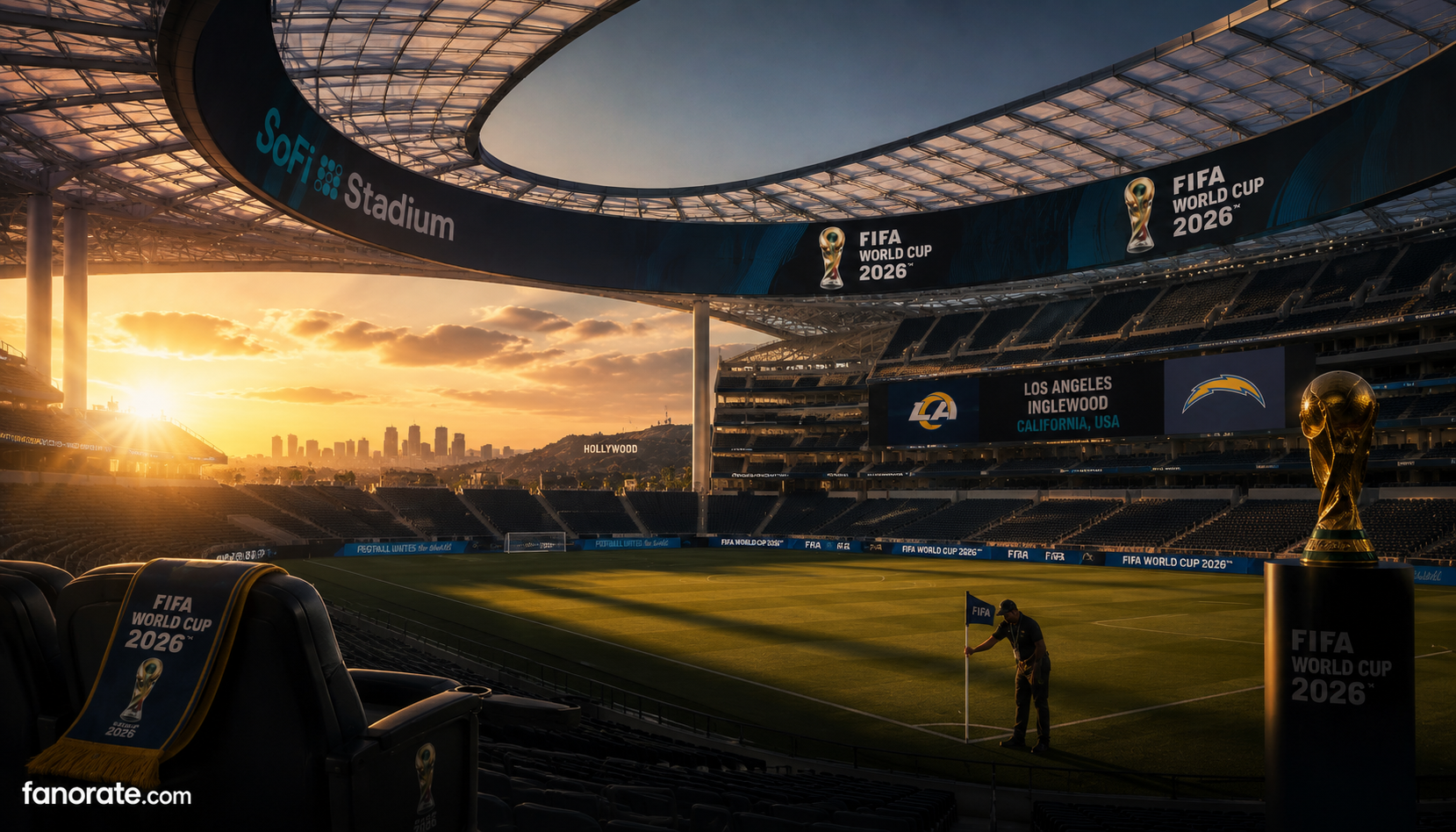
If MetLife is the closing scene of the 2026 World Cup, SoFi is the spectacle in the middle. Eight matches under a translucent sky. Eight nights of crowds from every continent walking into a building that looks like it was designed in a future LA. Tacos at midnight after a Round of 16 thriller. A Quarterfinal that will probably break ten records before its final whistle.
Los Angeles has been ready for this for thirty years. The 2026 tournament is just the show that catches up with the city.
If you’re going: rideshare, hydrate, get to the plaza early, and don’t leave Hollywood Park until the post-match crowd has thinned.
If you’re watching: pay attention to the screen as much as the field. The two experiences are designed to live together inside this stadium, and what you see on television is closer to the actual fan experience than at any other venue in the tournament.
FAQ
How many people does SoFi Stadium hold? The standard configuration seats around 70,000. For marquee events, capacity can expand past 100,000 with additional seating tiers.
Which FIFA 2026 matches will be played at SoFi Stadium? SoFi hosts eight matches, spanning group-stage games and four knockout rounds, including a Quarterfinal.
Is SoFi Stadium covered or open-air? Both. The fixed translucent canopy covers the seating bowl, but the sides of the stadium are open to the outdoors.
How do I get to SoFi from LAX? By car or rideshare, roughly 30–45 minutes on a matchday. Public transit options include Metro rail with a connecting shuttle.
What’s the closest neighborhood to stay in for the World Cup? Inglewood is closest, with Hollywood Park dining and entertainment adjacent to the stadium. El Segundo and Manhattan Beach are practical alternatives close to LAX.
What is the Infinity Screen? A massive oval video board suspended above the field — the largest of its kind in any stadium — visible from every seat with displays facing in every direction, including straight down toward the pitch.
What weather should fans expect? Mild and dry. Daytime highs in the 70s and 80s Fahrenheit, cool evenings, almost no rain in June and July.
Will the playing surface be grass or turf? Natural grass for the tournament, installed specifically for FIFA 2026.
Is the area around the stadium walkable? Hollywood Park, the development around SoFi, is highly walkable. Walking to and from the broader LA neighborhoods is generally not realistic.
Where is the best fan zone? The Hollywood Park plaza is the primary on-site fan zone. Larger FIFA Fan Festivals are expected in downtown LA, Santa Monica and other major districts.